01Operations·10 min read
When to hire a COO — and why fractional often comes first
The signs you’re ready for a chief operating officer, the trap of hiring one too early, and why a fractional COO is frequently the smarter first move.
Fractional COO & Business Excellence
A fractional operating partner for companies that have outgrown improvisation — bringing the governance, quality systems and measurement that let growth hold its shape.
New to the idea?
If your company is growing but almost everything still runs through you, that is the problem I solve. A fractional COO is an experienced operations chief who works with you part-time — so you get senior leadership running the business day to day, without the cost or commitment of a full-time hire.
I come in a few days a week, build the systems that let the company run without you in every decision, and then hand them back to your team.
It is not consulting — I do not hand you a deck and leave. I take ownership of how the work runs, install the cadence and quality that make growth hold its shape, and stay accountable for the result until your team can carry it without me. Senior operating leadership, sized to where the company is now.
Operating experience across global brands including


Does this sound familiar?
Most people who need a fractional COO never go looking for one — they just know something has stopped holding. See if any of these land.
The business can’t move without you — every decision waits on you.
Quality slips the moment things get busy.
You’re growing, but it feels harder, not easier.
Good people work hard, yet things still fall through the cracks.
You can’t see what’s really happening in operations until it’s a problem.
You need senior operations help — but a full-time COO is too much, too soon.
Recognise two or more? That is usually the moment.
Book a consultation01Positioning
A fractional operating partner for companies that have outgrown improvisation.
There is a stage every growing company reaches where effort stops being the constraint. The team is working hard; the results are getting harder. Decisions queue behind the founder. Quality depends on the same few people. Each new client or market exposes a seam the structure was never built to carry.
I install what is missing — the operating cadence, the quality systems, the governance and measurement — so growth holds its shape instead of bending under its own weight. Then I hand it back.
Evidence
$750M+
in annual media spend overseen
500+
global clients served
$20M+
in billings protected — Makegoods QA
95 → 99%
quality across 2,000+ campaigns, 450 clients
Most of this work is done under confidentiality. The numbers are real and measured; the client names are held in confidence except where cleared. That is the nature of operating inside a business rather than presenting about it.
02Approach
The method is consistent across every engagement: understand how the work truly moves, change it on the evidence, and leave behind something the team can run without me.
Good outcomes that depend on heroics do not survive scale. The work is to design how the work works — so quality is structural, not personal.
Opinion is where most transformation goes wrong. Map the real process, put numbers on it, and let the evidence decide what changes.
An engagement that creates dependence has failed. Everything is documented and transferred — the improvement should outlast my involvement.
How it works
Most engagements follow the same arc — and every one is designed to end with your team holding the operating model, not me.
A few weeks inside the business — reading the numbers and tracing how work moves from sale to delivery to cash — ending in a written read on where the operating model is straining and what to do first.
The operating cadence, unambiguous ownership of every critical process, and the small set of metrics leadership actually steers by. The point is fewer, sharper decisions that stop waiting on one person.
The quality systems, review gates and measurement that make good outcomes repeatable — so problems surface while they are still small and cheap to fix, not after they reach a client.
Everything documented and handed to your team, or to the full-time COO you are now ready to hire. The engagement is built to end cleanly, leaving the company more capable than dependent.
03Services
Engaged together or singly — from an embedded operating seat to CEO advisory, an interim mandate, or a focused quality audit.
An operating partner inside the business — not a deck about it.
A clear, evidenced read on how good your operation really is — and where it will break.
Rebuilding how the work flows — measured, not just reorganised.
The measurement and decision rights that let leadership steer, not guess.
A standing operating counsel — someone to think with before the decision hardens.
Full-time operating cover for the months the seat cannot stay empty.
A working operator in your corner while you grow into the job.
An operator’s read on the target before the money moves.
A programme office that produces decisions — not status theatre.
The few numbers leadership should steer by, on one source of truth everyone believes.
Who I help
The problems rhyme across industries, but each has its own failure modes. These are the ones I know from the inside.
Digital publishers and high-velocity content operations.
Output is capped by how work moves through the team — invisible queues, late quality checks, no real-time view of throughput.
Global agencies and in-house media teams running delivery at scale.
Delivery shortfalls surface late and become makegoods; quality varies across teams and markets; margin leaks through rework.
Delivery centres and global business services serving many clients.
Quality is asserted, not measured; SLAs slip under load; leadership can’t see across clients until it’s a problem.
Companies between roughly 50 and 500 people that have outgrown improvisation.
The founder has become the operating system — decisions queue, quality depends on a few people, growth feels harder.
Larger organisations running the same processes across many entities or markets.
Processes accrete differently in every entity; cycles run long; there’s no single trusted view of performance.
D2C brands and e-commerce operators scaling fulfilment, customer experience and cash cycles.
Operational complexity compounds with every SKU and channel; returns quietly eat the margin; fulfilment holds together on a few heroic people.
SaaS companies whose post-sale operations — onboarding, customer success, renewals — strain under growth.
Onboarding stretches, churn is discovered at renewal, CS quality depends on individuals, and revenue ops runs on different numbers from delivery.
Funds, boards and operating partners who need an embedded operator inside a portfolio company.
The value-creation plan stalls in operations; board reporting is narrative, not numbers; the 100-day plan has no cadence underneath it.
GCCs in India that own critical processes for a global parent — and carry the burden of proving it.
Quality is asserted to HQ rather than proven; SLAs sprawl across internal clients; the centre is still argued for on cost rather than capability.
04Selected results
Long-form case narratives — challenge, intervention, outcome — with the real figures.
$20M+
Advertising & media operations
A three-step Makegoods QA framework that protected $20M+ in billings
95% → 99%
Enterprise delivery operations
Lifting quality from 95% to 99% across 2,000+ campaigns
2 months → 15 days
Finance operations
Compressing the billing approval cycle from two months to fifteen days
05Insights
Common questions
A fractional COO is an experienced chief operating officer who works with a company part-time — typically one to three days a week — instead of as a full-time hire. You get senior operating leadership embedded in the business, sized and priced for a company that needs the capability but not yet the full-time seat.
A consultant studies the problem and hands you a recommendation. A fractional COO owns the operating outcome alongside your team — installing the cadence, building the systems, and being accountable for whether they actually work. The deliverable is a better-running business, not a deck.
An interim COO is a full-time placeholder filling a vacancy until you hire permanently. A fractional COO is part-time by design and there to build operating systems and capability — not to occupy the seat. You use a fraction of their time, focused on the highest-leverage work, and they hand it back.
Usually when growth has outpaced the operating model: the founder has become the bottleneck, quality depends on a few key people, and every new client or market exposes a seam. The company needs operating discipline but cannot yet justify — or find — a full-time COO.
Engagements are monthly retainers scaled to scope and cadence — never billed by the hour. A fixed-fee diagnostic gives a low-commitment way to start. Pricing reflects senior operating leadership, and is set against the cost of the problem it removes rather than days worked.
For most companies at this stage, yes — meaningfully. You pay for a fraction of a senior operator’s time rather than a full executive salary, equity and overhead, and only for as long as you need the capability. The point of "fractional" is senior leadership at a fraction of the full-time cost.
Most start with a short, fixed-fee diagnostic, then move into an embedded retainer of one to three days a week over six to twelve months. It begins by mapping the operating model, installs cadence and ownership, builds the quality and governance layer, and ends by handing a documented system to your team.
Weeks one to four: diagnose — sit in the meetings, read the numbers, map how work really moves. Weeks four to eight: install the operating cadence and unambiguous ownership. Weeks eight to twelve: stand up the quality and governance layer and the few metrics leadership steers by. You should feel decisions speed up within the first month.
Start with a conversation. We discuss where the operating model is under strain and whether a diagnostic is the right first step. From there, the diagnostic gives both of us the evidence to decide whether — and how — a fuller engagement makes sense.
Yes. Engagements are remote-first and global teams across time zones are familiar territory — much of my work has spanned international clients and delivery hubs. On-site time is added where a diagnostic or operating review genuinely benefits from being in the room.
06About
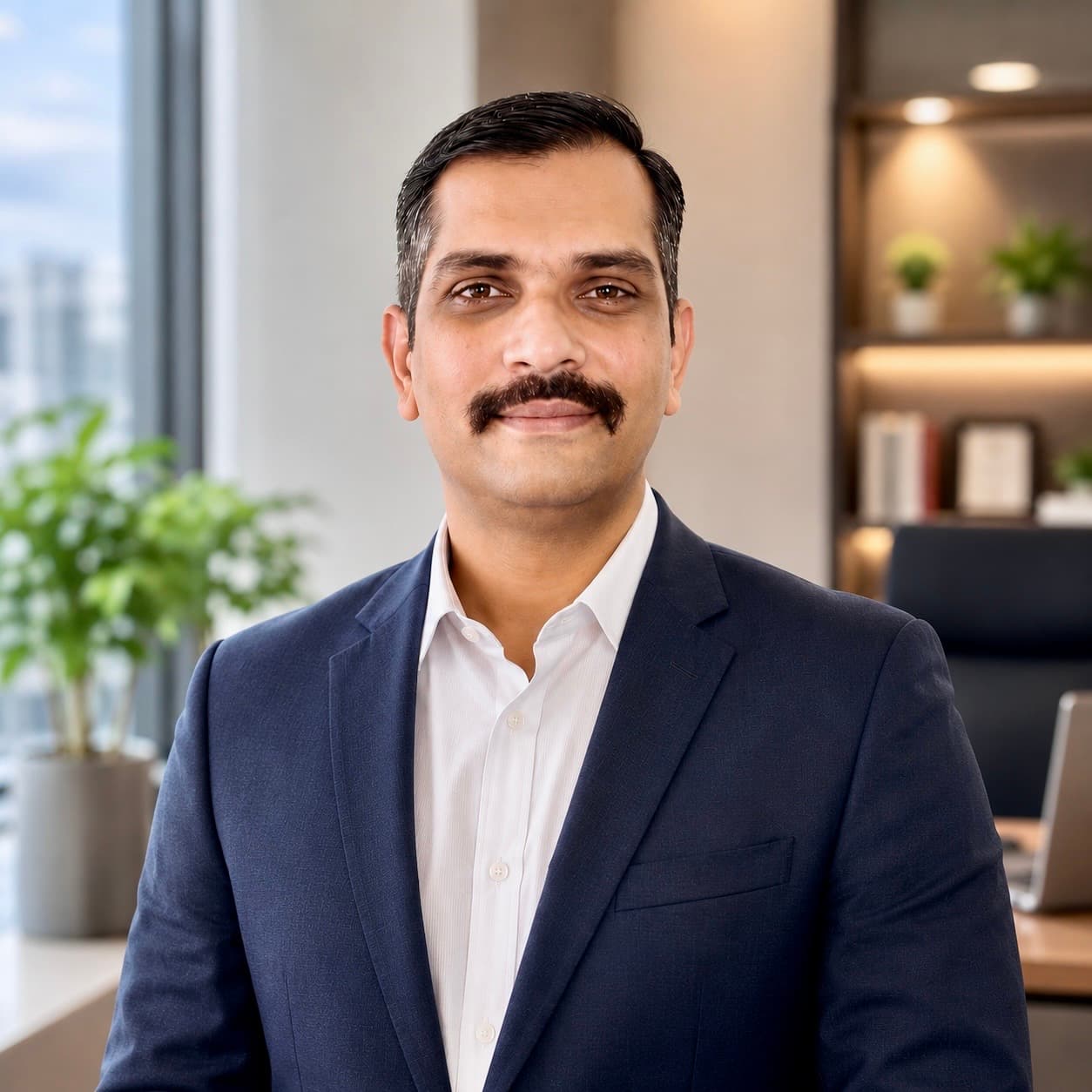
Ashish Kumar Agnihotri has spent 19 years making operations work — from an engineering foundation and a postgraduate qualification at XLRI Jamshedpur to Senior Director, Business Excellence at Publicis Groupe, where he led quality and delivery across global digital operations: more than USD 750 million in annual media spend, teams of 2,000+, and 500+ clients including Disney, Samsung, Adobe and P&G. A Lean Six Sigma Green Belt, he now works independently as a fractional COO and Business Excellence advisor.